In modern power transmission and distribution systems, ACSR Conductor, AAAC Conductor, and AAC Conductor are the three most commonly used types of overhead electrical conductors.
They are widely used in:
- Power transmission lines
- Distribution networks
- Rural electrification projects
- Industrial power systems
Each type offers different performance in terms of conductivity, strength, corrosion resistance, and cost efficiency.
Structure
ACSR Conductor is composed of aluminum strands wrapped around a steel core.
Keywords
- ACSR conductor strength
- steel reinforced aluminum conductor
- high voltage overhead line ACSR
Features
- High mechanical strength due to steel core
- Suitable for long-span transmission lines
- Good conductivity
- Widely used in high-voltage projects
Applications
- High-voltage transmission lines
- Long-distance power networks
- Mountainous and challenging terrains
Structure
AAAC Conductor is made entirely of high-strength aluminum alloy.
Keywords
- AAAC conductor advantages
- corrosion resistant aluminum alloy conductor
- AAAC overhead cable
Features
- Excellent corrosion resistance
- Lighter than ACSR
- Better electrical performance in coastal environments
- Low maintenance cost
Applications
- Coastal and high-corrosion environments
- Urban power distribution systems
- Medium and high voltage networks
Structure
AAC Conductor is made of pure stranded aluminum.
Keywords
- AAC conductor application
- aluminum stranded conductor
- low voltage overhead AAC cable
Features
- Very high electrical conductivity
- Lightweight structure
- Cost-effective solution
- Lower mechanical strength compared to ACSR and AAAC
Applications
- Urban low-voltage distribution systems
- Short-span overhead lines
- Light-load electrical networks
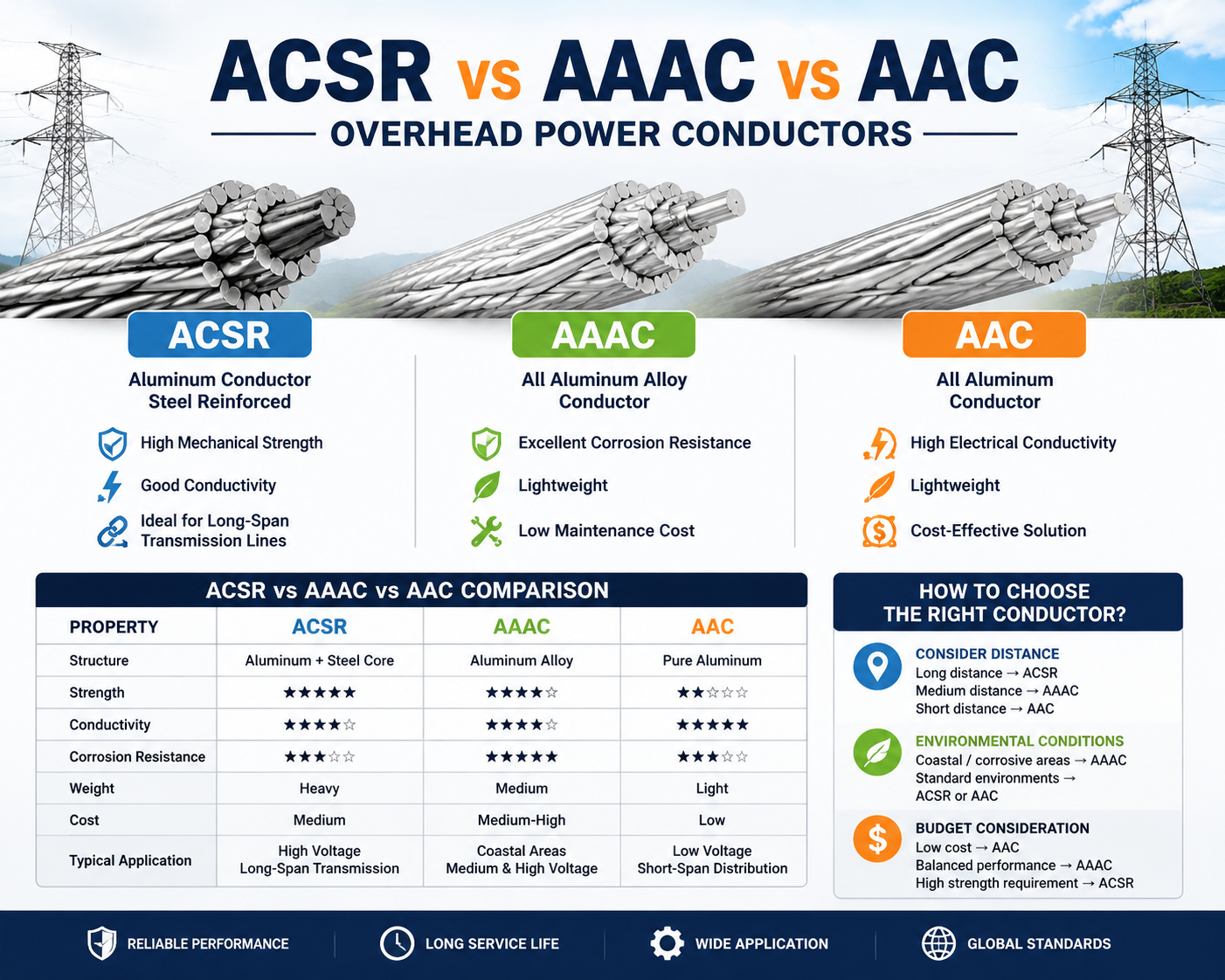
5.ACSR vs AAAC vs AAC Comparison Table
| Property | ACSR | AAAC | AAC |
|---|
| Structure | Aluminum + Steel Core | Aluminum Alloy | Pure Aluminum |
| Strength | ★★★★★ | ★★★★ | ★★ |
| Conductivity | ★★★★ | ★★★★ | ★★★★★ |
| Corrosion Resistance | ★★★ | ★★★★★ | ★★★ |
| Weight | Heavy | Medium | Light |
| Cost | Medium | Medium-High | Low |
| Application | High voltage long span | Coastal & medium voltage | Low voltage short span |
6.How to Choose the Right Conductor?
Selecting between ACSR Conductor, AAAC Conductor, and AAC Conductor depends on several key factors:
1. Transmission Distance
- Long distance → ACSR
- Medium distance → AAAC
- Short distance → AAC
2. Environmental Conditions
- Coastal / corrosive areas → AAAC
- Standard environments → ACSR or AAC
3. Budget Consideration
- Low cost → AAC
- Balanced performance → AAAC
- High strength requirement → ACSR
7.Conclusion
ACSR Conductor, AAAC Conductor, and AAC Conductor each play a crucial role in modern electrical power systems.
- ACSR: Best for high-strength, long-span transmission
- AAAC: Ideal for corrosion resistance and coastal areas
- AAC: Most cost-effective for low-voltage distribution
Choosing the right conductor ensures higher efficiency, improved safety, and optimized project cost for power infrastructure development.
ABC Cable: The Ultimate Guide to Overhead Power Lines
🔌 ACSR vs AAAC vs AAC: Complete Guide to Overhead Power Conductors
Why South America Imports Power Cables from ChinaWhy South America Imports Power Cables from China | 2026 Market Analysis
Case Study: Power Cable Supply for National Grid & Solar Projects in Ghana
Insights into the Cable Industry: Key Drivers Shaping the Future Market